
The Day We Loaded the Ship, It Rained for Seven Hours
Forty-seven used machines had to make one sailing. The rain started as we loaded the third. Two machines missed the ship, and we paid for it. Here is the timeline of that day, and the bill.
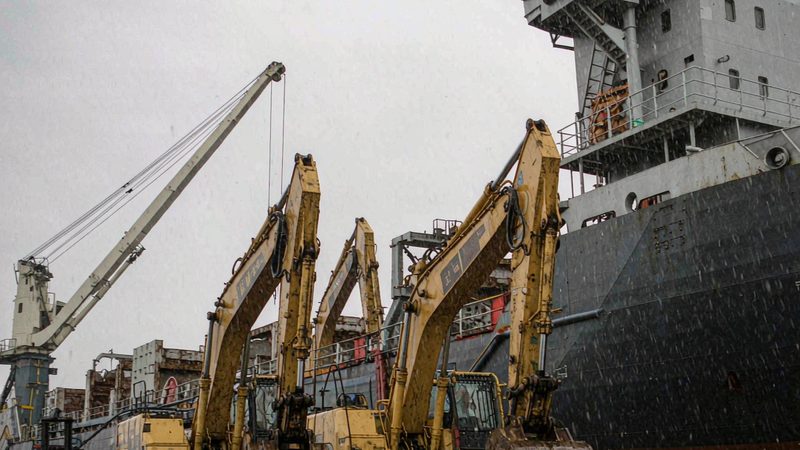
October 9, Nansha. Forty-seven used machines were going on one ship, three of them added by the customer at the last minute.
The carrier's customs cutoff was 11 p.m. that night. We started loading at eight in the morning. By the third machine, the sky turned overcast. By three in the afternoon, the rain came down.
You can't stop in the rain, but you can slow down
Getting wet is not what kills a machine. What kills it is that nobody wipes it down afterward. Hydraulic line fittings, electrical connectors, the wiring harness under the seat — water in these places becomes a failure in the customer's hands two months later.
Our method was crude: before each machine went into the container, we blew the fittings dry with compressed air and wrapped them in self-adhesive tape. Twelve extra minutes per machine. Forty-seven machines — more than nine hours.
So that day we didn't stop. We just went slower.
The sling on the fourth machine
Around seven in the evening, while loading the fourth machine, one of the lifting slings started to fray.
Lao Wang spotted it first. He has been in this trade nineteen years; his eyes beat a flaw detector. He said this one was done, and I said swap it. We had six spares in stock; swapping took two minutes.
But those two minutes cost us a crane slot. The next three machines in line ran forty minutes late.
Forty minutes is nothing at a port. I've seen machines wait three days.
When the rain was heaviest, we were counting bolts
Eight thirty, the rain at its worst. Sweat inside the raincoats, water outside.
At that moment we were doing something that looked stupid: counting bolts.
However many bolts an excavator's counterweight, track shoes, and stick pins leave the factory with, that's how many there should be before loading. A ship rolls at sea; one bolt short becomes a claim at the destination port.
We checked them one by one with flashlights in the rain. Forty-seven machines, more than 130 bolts each on average. By the twentieth machine, Xiao Wang's flashlight had drowned, so I handed him mine.
Three machines came up short. Two were missing guard-plate bolts; we replaced them on the spot. One was missing a bolt at the base of the stick. We pulled the records: it had been removed during last month's inspection and never put back. Our own mistake, admitted on the spot.
Two machines didn't make it
10:40 p.m., two machines left.
One was the machine missing the stick bolt — we were still hunting for the part. The other was the customer's third last-minute addition; its customs paperwork was only completed at five that afternoon.
Eleven o'clock cutoff. Twenty minutes short.
We stopped. Not because we couldn't load them, but because we didn't dare — a machine forced onto the ship without cleared customs can't clear at the destination either, and demurrage runs over two hundred dollars a day, far more than the freight.
I called the customer. It was five in the afternoon in Tanzania; he picked up.
I said, two machines didn't make it, it's on me. The next sailing is in seven days, and we'll cover the freight.
He was quiet for a few seconds, then said: send me the photos of the other forty-five first.
What it cost us
Moving the two machines to the next sailing cost 34,200 yuan in total.
The breakdown:
Booking amendment fee: 800, for two machines.
Second customs declaration: 1,200.
Seven days of storage: 380 per machine per day, two machines for seven days — 5,300.
The freight difference on the next sailing: 26,900.
We paid it all. Not because the customer asked, but because we had dragged the schedule ourselves — of the three last-minute machines, we knew about the first two three days ahead, but the third was only told to us the day before loading, and we never raised the flag early.
The responsibility was ours, not the weather's.
What happened to those machines
Seven days later, the two machines went onto the next ship.
When they arrived, the customer inspected them himself. He sent back photos — the tape was still on the counterweights, the tape we had wrapped.
He said, you didn't peel the tape off.
I said, peel it back yourself and you'll see whether the fittings are dry. Your own eyes beat a hundred words from me.
Later he hired a local excavator to unload, and filmed it. In the video, the machine that had been short a bolt ran its stick smoothly, with no abnormal noise.
What we changed
After that day, we changed three rules.
First, last-minute additions must be declared seventy-two hours before the customs cutoff. Not that we refuse — but if it's late, we can't slot you in, and we'll tell you upfront that it won't make the ship.
Second, if it rains on loading day, we follow the rain procedure: twelve extra minutes per machine for blowing out the fittings. Those twelve minutes are now written into the schedule, not decided on the spot.
Third, parts removal slips and reinstallation slips must match one to one. This time a bolt taken off and not put back was caught by luck. Next time we might not be lucky.
How you can check us
If you're our customer, you can ask for three things:
Photos of each machine on loading day — we take four: front, both sides, nameplate, and hour meter.
Scans of the customs declaration and the bill of lading.
The inspection report for that machine, with numbers matching the photos one to one.
Ask, and we give. These were yours to begin with; you shouldn't have to ask.
Forty-seven machines; we loaded forty-five. Not a pretty number, but I'm writing it down. Next time it should be forty-seven.