
Our First Warehouse in Guangzhou: 200 Square Meters
Two hundred square meters, 4,200 yuan a month, no inspection pit, no lift. We worked out of that warehouse for eleven months and inspected over two hundred machines.
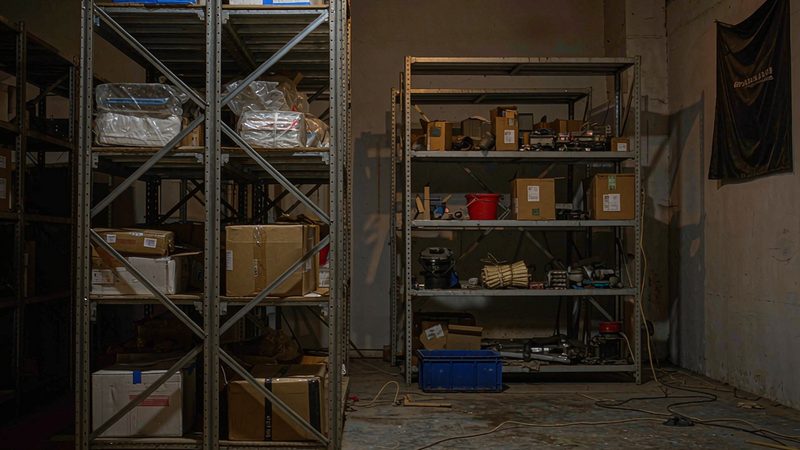
In August 2016, we rented our first warehouse in Guangzhou.
Panyu. Two hundred square meters, 4,200 yuan a month.
No inspection pit, no lift, no full roof. Half was open-air concrete, half was covered.
We worked there eleven months and inspected two hundred thirty-six machines.
Why Panyu
One reason: cheap.
We had less than 400,000 yuan in cash at the time, and we needed it to buy machines. Every yuan saved on rent counted.
That spot in Panyu was 47 kilometers from Nansha Port, a forty-minute trailer ride. Far, but the rent was a third of Nansha's.
4,200 a month, 50,000 a year. The thirty-odd thousand we saved was enough to buy one more machine.
What was in the warehouse
Three things.
One, a used pressure washer, bought for 2,800. Before inspection every machine had to be washed clean, or the grime would hide the leaks.
Two, a set of tools. Sockets, wrenches, calipers, a flashlight, a pry bar, all in a steel cabinet.
Three, one desk and two computers. One for storing photos, one for writing reports.
That was it.
How do you inspect an undercarriage without a pit
That was the hardest part.
To see the undercarriage you have to get under the machine. With no pit, we lay on the ground.
A plank on the concrete, lie down on it, shine the flashlight upward.
In summer the ground ran over fifty degrees Celsius; five minutes and your clothes were soaked. In winter the slab was ice cold and lying on it too long made your back ache.
Lao Li was forty-seven then, lying under a dozen machines a day. His back was ruined in those months; he still wears medicated patches.
We calculated it later: checking an undercarriage lying on the ground took twenty-five minutes per machine. With a pit, twelve minutes.
And lying down, you couldn't see everything. The inner side of the track rollers, the underside of the slewing bearing — out of view.
So in those eleven months, our undercarriage calls on more than twenty machines were wrong.
Wrong how
Over twenty machines, mainly in three ways.
First, leak diagnosis. Lying down you see the oil traces but can't tell where the leak starts. On eight machines, the customer found the leak was the swing motor seal, not the hose fittings we had called.
Second, track roller wear. The outer side is visible; the inner side isn't. On nine machines, customers reported roller noise; we opened them up and found the inner sides worn.
Third, bent belly guards. Lying down you only see part of the guard. On three machines, a deformed guard left too little ground clearance and the customer bottomed out on site.
Those twenty-plus machines cost us over 300,000 yuan in compensation.
Why we stayed eleven months anyway
Because a warehouse with a pit cost three times the rent.
We did the math: 8,400 more a month, 100,000 a year. Our losses from not having a pit were over 300,000 a year.
On that math, we should have moved long before.
We dragged it out eleven months because cash was tight. Money was tied up in inventory; we couldn't come up with the fit-out cost.
Looking back, it was a bad decision. Some money must not be saved.
The day we moved
In July 2017 we moved into a warehouse with inspection pits.
Eight hundred square meters, 18,000 a month. Two pits and a lift.
Moving day, Lao Li stood for a while on the old concrete floor.
He said, I've laid on this ground over two hundred times.
I said, you won't have to anymore.
He said, good.
What that warehouse taught us
One, never skimp on inspection hardware. Pits, lifts, lighting — necessities, not luxuries. The money you save gets paid back tenfold in claims.
Two, photos need standards. Many photos from those eleven months had no reference object, so you couldn't judge size. Later we set a rule: every close-up must include a ruler, a coin, or a finger.
Three, protect the inspectors. Lao Li's back was the lesson. Now our inspectors get creeper boards and back supports, and the pits have handrails.
Four, don't trade health for speed. Back then we inspected six machines a day; everyone was exhausted and the error rate climbed. Now it's four a day, maximum.
Today
We now run three sites: the eight-hundred-square-meter yard in Panyu, a twelve-hundred-square-meter lot by the Nansha docks, and a sorting warehouse in Dongguan.
Over three thousand square meters combined, 146,000 yuan a month in rent.
Thirty-six times the old 4,200.
Sometimes when I pass through Panyu I look over at that old warehouse. An auto-parts business uses it now.
On that concrete slab lies a year of my life spent under machines.