
What Keeps a Generator Set Running for Ten Years
The same generator set, still spinning after ten years. We opened it up and wrote down both what carried it through the decade and what finally wore out.
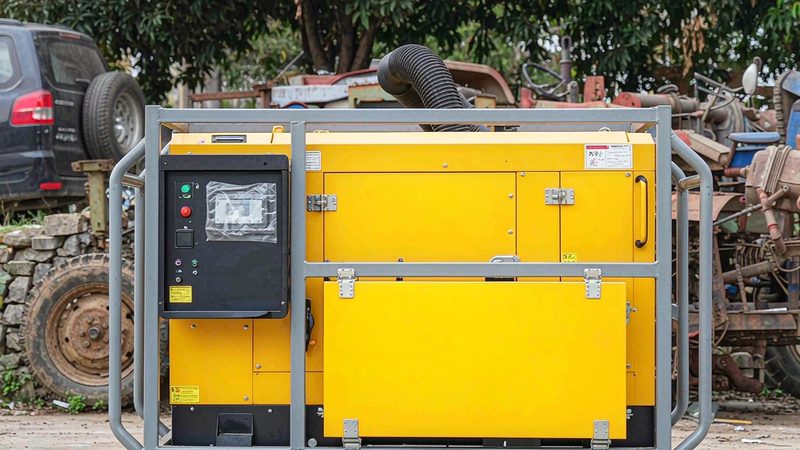
In February 2018, we revisited a generator set we had sold back in 2008.
300 kW, Cummins engine, Stamford alternator. Ten years of service at a mine in Zambia.
The machine was still running. We opened it up for inspection and wrote down the results.
How long it ran in ten years
The set has a running-hour meter. The reading: 43,800 hours.
Ten years, 43,800 hours. Twelve hours a day on average.
Not extreme, but not low either. A typical standby set runs only a few hundred hours a year; this one was the primary power source.
What we found inside
The engine first.
Cylinder liners: wear within limits. We measured the bores — maximum wear 0.18 mm against a limit of 0.4 mm.
Piston rings: the second ring was worn beyond spec, gap at the upper limit. Replace.
Crankshaft bearings: light scoring on the lower shells, but nothing worn through. Still serviceable — we recommended replacing anyway.
Valves: carbon deposits on the intake valve sealing faces; valve guide clearance normal.
Turbocharger: no impeller contact marks; axial play 0.09 mm, normal.
Then the alternator side.
Stator windings: insulation resistance measured 350 megohms against a standard of over 5 megohms. Better than we expected.
Rotor: no rubbing marks.
Bearings: slight noise in the rear bearing — replace.
Excitation system: the AVR module had aged; output voltage fluctuated more than a new unit's.
Why it lasted ten years
Our analysis: three reasons.
One: maintenance on schedule
The mine keeps a maintenance logbook, kept since 2008.
Oil and oil filter changed every 250 hours — never once missed.
Fuel filter and water separator every 500 hours.
Air filter checked every 250 hours, replaced when dirty. The mine is dusty; in practice they changed it every 200.
Coolant every 2,000 hours.
It was the best logbook we've ever seen.
Plenty of people think a generator needs no attention once installed — fix it when it breaks. That's wrong. On-schedule maintenance versus fix-when-broken is a difference of three times the service life, or more.
Two: a sensible load factor
What a generator fears most is running at low load for long periods.
Low load (below 30 percent of rated power) causes incomplete combustion, heavy carbon buildup, and faster liner wear — the phenomenon called wet stacking.
Based on the operating logs, this set's actual load factor sat between 65 and 80 percent long-term. The ideal band.
When the mine specced it, they chose 300 kW against a real load of about 200 kW. That margin was right.
We've seen too many cases of oversized sets on small loads — ruined within a year.
Three: fuel quality
The set runs on the mine's own stored diesel, settled and filtered.
They have a twenty-ton storage tank. Incoming fuel settles for seventy-two hours, then passes through two stages of filtration before reaching the set.
The injectors we pulled showed little carbon and good atomization — proof of clean fuel.
Fuel is the number-one killer of diesel generators. We've seen water in fuel scrap an entire set of injectors — over 30,000 yuan a set.
What didn't hold up
Some things were due.
The rear bearing had to go. Ten years — its life was up.
Piston rings and bearing shells, recommended replacement. Usable, but risky to keep running.
The AVR module had to be replaced; voltage fluctuation harms downstream equipment.
All rubber parts had aged — coolant hoses, intake piping, every seal — all replaced.
In the control cabinet, some contactor and relay contacts were burned — replaced.
Total for a mid-life overhaul: about 110,000 yuan. A new set of this size costs over 1.2 million.
Spend 110,000, run five more years.
What this machine taught us
We changed how we sell generator sets afterward.
First, always pin down the load before selling.
We have the customer list every device to be powered, its wattage, and the simultaneity factor, then we calculate the total load. We recommend a set rated around 1.25 times that total.
We don't quote anyone who won't tell us the load.
Second, every set ships with a maintenance chart.
It spells out every service interval, the oil spec, the filter part numbers. The chart is bilingual, Chinese and English, posted right on the set.
Third, every set ships with first-service consumables.
Oil, oil filter, fuel filter, air filter — one full set. The customer can run the first year without hunting for supplies.
Costs us eight hundred-odd yuan. We give it free.
Fourth, build a parts file.
For every set we record the engine serial, the alternator serial, and the controller model. When a customer reports a fault, they just give us the numbers.
About used generator sets
Our used generator sets come mainly from factory standby units and rental-company retirements.
Both sources share one virtue: low hours with disciplined maintenance. Many factory standby sets run only a few hundred hours in five years — but get test-run weekly.
Those are the sets we buy most.
To judge a used generator set, two things matter most: running hours, and maintenance records.
Read the hours from the controller, not just the mechanical meter on the frame.
Take the maintenance records if you can get them. If you can't, price it as a no-records machine, one grade lower.
To close
That machine is still running in Zambia. The customer took our overhaul plan — 110,000 yuan, done at the end of last year.
This January they sent photos. On the control cabinet, the maintenance chart we pasted in 2008 is still there, the paper gone yellow.
They said it can run five more years.
I said it can. Maintained right, a generator is one of the most durable machines there is.