
What Actually Determines the Price of Used Equipment
Two Komatsu 200s, same model, same year — one priced at 460,000, the other at 310,000. The 150,000 gap breaks down across eight variables. This article takes them apart one by one.
Last month a customer came to our warehouse with our quotation sheet, pointed at two excavators, and asked: same model, same year — why is this one 460,000 and that one 310,000?
I've been asked this question at least a hundred times. By customers, and by newcomers to the trade.
Used equipment has no list price. The price is computed one variable at a time. This article breaks down eight of them.
Year and hours
Year is the skeleton. Excavators move in three-year generations: a post-2011 machine and a 2008 machine are a generation apart in structure — electrics and hydraulics are both different — and the price gap starts at fifty thousand.
Hours are the flesh. Normal usage is 1,500 hours a year. An 8,000-hour machine and a 12,000-hour machine differ by fifteen to twenty percent.
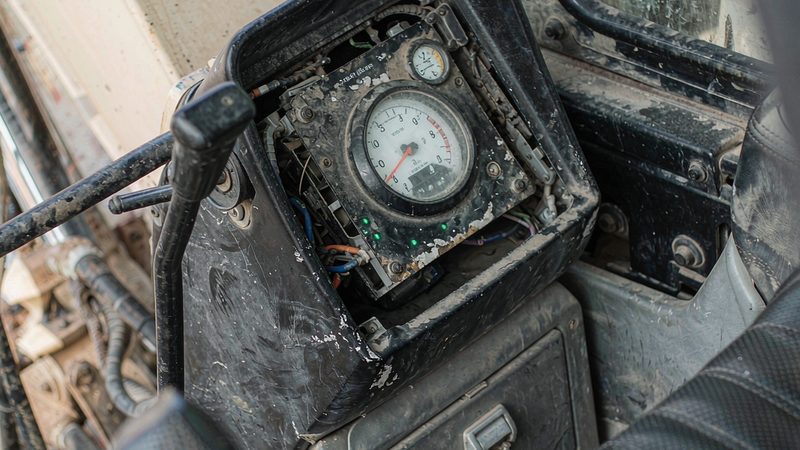
Watch out: hour meters can be rolled back. We don't buy rolled-back machines, and you shouldn't either. To check, look at pedal wear, seat sag, and the sheen on the control levers. If those don't match the hours, the meter was rolled. Meters can be rolled; pedals can't.
The year hides one more thing: emissions. Most post-2011 machines carry electronic controls that old-school mechanics can't fix. Some markets value that; others actually dislike it as fussy.
Working conditions and repair history
The same 10,000 hours means two different machines on a municipal site versus a mine. A mining machine's structure is covered in scars — frame, tracks, bucket teeth all damaged — a twenty percent price gap.
First question when inspecting: what work did it do? If the seller can't say clearly, price it as the worst case. If he says municipal work but the bucket teeth are ground flat, that's rock work.
Tunnel work counts as harsh duty too — damp, dusty, and the electricals age fast. While asking about conditions, check the lights and horn on top of the cab; on tunnel machines those have all been replaced.
Repair history needs paperwork. An engine overhaul doesn't disqualify a machine: with documents showing a proper shop did the work, deduct ten percent; without documents, deduct twenty-five — because you don't know what was fixed or what parts were used.
Brand and local demand
Brand gap is a hard gap. Same year, same hours: a Komatsu costs forty percent more than a Chinese brand. The reasons are in an earlier article: parts and operators. We don't set that gap — the market does.
Sometimes it flips. The Myanmar market favors certain Chinese brands because Chinese crews work there in numbers. Brand gap has to be asked about market by market.
Local demand floats. In 2016, when Zambia's copper mines expanded, twenty-ton-class excavators rose ten percent locally. The same machine shipped to Zambia versus Tanzania — a thirty thousand difference in sale price.
That's why we always ask for the destination port before quoting. It's not nosiness — the money is baked into the price. Delivered price and FOB price are two different businesses.
Exchange rate and sailing schedule
These two variables are invisible to buyers, but they're in the price.
Exchange rate: we buy machines in RMB and collect dollars from customers. From 2015 to 2016, the yuan moved from 6.2 to 6.9 per dollar — a difference of over ten thousand per machine. That's why we only dare write a seven-day validity on quotes.
So besides the validity period, our quotation sheets carry one line of small print: if exchange rates move more than two percent, both parties renegotiate. That line has saved us twice.
Sailing schedule: in peak season, freight on one forty-foot container to East Africa can swing by eight hundred dollars. Catch an end-of-month vessel chasing volume and freight drops, so the delivered price can give a little. When a customer urges us to ship, we're more anxious than he is — waiting for one cheaper sailing can save the price of a motorcycle.
The schedule also sets arrival timing. A machine that arrives before the rainy season sells well; one that arrives during the rains gets bargained down. Veteran sellers all count this gap.
Comparing the two machines
The two machines from the beginning: both Komatsu 200, both 2010, parked in the same row of our warehouse.
The 460,000 one: 7,800 hours, municipal duty, complete service records, eighty percent original paint, going to Kenya on a low-freight sailing.
The 310,000 one: meter reads 9,500, realistically 11,000-plus, mining duty, boom repaired by welding, no paperwork, customer pays peak-season freight himself.
The 150,000 gap spreads across eight variables, each with a number: same year; twenty to thirty thousand from hours; thirty thousand from working conditions; thirty thousand from repair history; twenty thousand from freight; the rest is brand and demand fluctuation.
It's not black-box pricing — the machine condition and demand are right there. I took the customer up into both machines myself. He circled the cheaper one twice, climbed in, ran it for ten minutes, got down, and asked: can this one go any lower? I said no — it's a machine worth exactly its price. He bought the expensive one in the end.
How you should bargain
Don't bargain against the total price — bargain against the variables.
Ask for service records; no records means the no-records discount. Ask for corroboration of the hours — look at pedals and seat. Pin down the working conditions; a mining machine gets the mining price.
What you bargain off is water weight; what you can't bargain off is machine condition. Separate those two, and you won't be fooled by a low price or miss a good machine.
Eight variables, but it comes down to one sentence: every machine has its own price. Anyone who tells you one flat price covers everything is hiding something.
Every variable on our quotation sheet can be written out plainly. A machine that can't be written out clearly — don't take it at any price.